 BurtonSoftware
01 Service Positioning
Burton provides integration services for cross-border 3PLs, overseas warehouses, brands, and omnichannel fulfillment teams. The objective is not only to transfer orders, but to build a traceable loop across orders, products, inventory, warehouse execution, shipment confirmation, billing, and exception handling.
02 Capability Status
| Status | Meaning | Customer Action |
|---|---|---|
| Standard | A common capability or enabled connector is available. | Complete configuration, mapping, and integration testing. |
| Configuration Required | Capability exists but must be enabled for the client, warehouse, or channel. | Provide business scope and configuration inputs. |
| Custom Assessment | An adapter, transformation, or dedicated workflow is required. | Provide API documents, samples, and acceptance criteria. |
| Roadmap | A possible product extension with no committed delivery. | Enter requirements and roadmap review. |
Extensibility described here supports solution discussion and is not a commitment to a specific platform, date, or feature. Formal scope follows the mutually approved solution, schedule, and acceptance document.
03 Customizable Scope
- External ERP / OMS order intake, change, and cancellation.
- Client, product, SKU, kit, lot, and UOM mapping.
- Multi-warehouse routing, allocation, split, and priority rules.
- OAuth, API key, signed API, webhook, SFTP, CSV, and EDI.
- Inventory snapshot and change, order status, shipment, and tracking confirmation.
- Labels, carriers, service codes, BOL, ASN, and client-specific documents.
- Dedicated reports, reconciliation files, exception dashboards, and alerts.
- AI-assisted field mapping, root-cause analysis, log summaries, and response guidance.
04 Enterprise Extension Direction
Burton's integration architecture can expand through reusable connectors, a unified order model, rule orchestration, event subscriptions, observability, and AI-assisted operations. Complex customers may assess multi-entity, multi-client, multi-warehouse networks, regional routing, lot traceability, client-level SLA, and financial reconciliation.
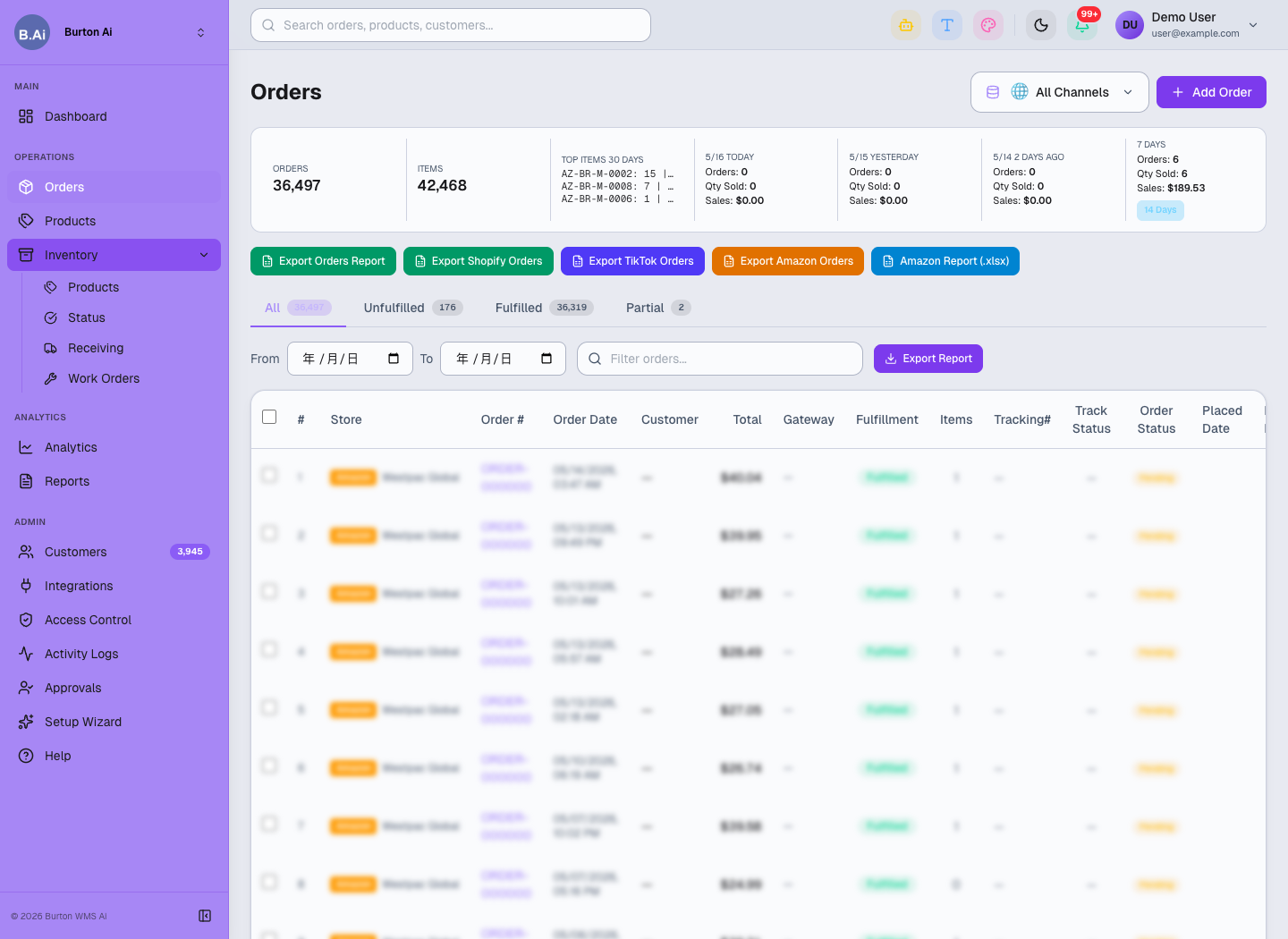
The unified order workspace supports warehouse execution, exception tracking, and customer service.
05 Delivery Process
- Discovery: confirm systems, objects, direction, frequency, volume, and ownership.
- Design: document data flow, mapping, status model, security, and exceptions.
- Configure or develop: reuse standard connectors first and implement approved differences.
- Integration test: cover success, duplicate, missing field, timeout, cancellation, and callback failure.
- UAT: sign off against sample orders and agreed acceptance criteria.
- Production rollout: enable in stages, monitor, and reconcile.
- Optimization: improve rules using exceptions, lead time, and business growth.
06 Assessment Inputs
Provide system name and version, API documentation, authentication, business flow, sample payloads, average and peak order volume, inventory definitions, warehouse and carrier rules, callback requirements, error samples, and preferred rollout window.